A veteran teacher said something to me recently that perfectly captured what many educators are feeling right now. She told me that earlier in her career, even difficult classes still felt predictable. There were disruptions, arguments, and challenging students, but most days she felt confident she could settle the room and get everyone back on track.
Now, she said, it feels different.
Not worse in every way. Just different.
Students seem more emotionally reactive. Small conflicts escalate faster. Attention spans feel shorter. Frustration surfaces more quickly. Some students walk into class already overwhelmed before instruction even begins. And many teachers are quietly wondering the same thing: Why does classroom management feel so much harder than it used to?
The answer is not simply that “kids have changed” or that teachers suddenly became less effective. The emotional environment inside classrooms has changed, and many traditional conversations about behavior management have not fully caught up to that reality.
Behavior Is Often About Regulation, Not Just Discipline
One of the biggest misconceptions about student behavior is that it is mostly about compliance. In reality, behavior is often connected to emotional regulation.
When students feel calm, safe, connected, and emotionally balanced, they generally process correction more effectively. They can pause, reflect, redirect, and recover from frustration more easily. But when students are stressed, anxious, overstimulated, embarrassed, emotionally overloaded, or constantly operating in a heightened state of alertness, the brain responds differently.
Teachers see this every day. A student gets redirected and immediately becomes defensive. Another shuts down over a relatively small correction. Another turns everything into humor because joking feels safer than vulnerability. Another escalates publicly because emotional regulation disappeared long before the teacher addressed the behavior itself.
This does not mean students should avoid accountability. Structure and boundaries still matter tremendously. But understanding how stress affects the brain helps explain why some traditional behavior strategies feel less effective in emotionally overloaded environments. Students today often carry far more emotional stimulation throughout the day than many adults realize, and teachers absorb that energy constantly.
Teachers Feel the Emotional Climate Too
One thing that rarely gets discussed honestly enough is how emotionally demanding classroom management has become for teachers themselves. Teaching has always required patience, consistency, and emotional awareness. But many educators now spend large portions of the day monitoring emotional tension in addition to teaching content.
That takes energy.
When adults spend hours redirecting behavior, de-escalating conflict, monitoring classroom dynamics, and anticipating disruption, the nervous system stays highly activated. Over time, even excellent teachers can start feeling emotionally drained by the constant intensity. That does not mean they are ineffective. It means they are human.
Ironically, many teachers blame themselves for struggling in environments that would challenge almost anyone. But recognizing that classrooms have changed is not negativity. It is clarity. And clarity matters because it allows educators to adapt rather than simply feel defeated.
Why Predictability Matters More Than Ever
One of the most important things students need right now is emotional predictability. Strong classroom management is not always about being the strictest person in the building. Often, it is about creating environments that feel calm, consistent, and emotionally stable.
Students tend to function better when they know what to expect, how transitions work, how adults will respond, where boundaries exist, and how conflict will be handled. Predictability lowers emotional tension. That is why many highly effective teachers focus heavily on routines, consistency, and emotional steadiness. Their classrooms often feel calmer because students are not constantly trying to interpret unpredictable emotional reactions from adults.
The goal is not perfection. The goal is to reduce unnecessary emotional friction so more energy can go toward learning.
Calm Authority Works Better Than Constant Escalation
Some of the strongest classroom managers I have seen were not loud people. They were steady people.
Students knew the teacher meant what they said, but they also knew the classroom was emotionally safe. Corrections were direct without becoming humiliating. Expectations stayed consistent. The teacher did not emotionally escalate every situation.
That matters because emotions are contagious. A classroom can become tense very quickly when emotional reactions begin bouncing back and forth between students and adults. Teachers who stay calm during moments of conflict often de-escalate situations faster than teachers who respond emotionally in the moment.
Simple phrases like “We’ll talk in a minute,” “Take a breath and reset,” or “You still have an opportunity to fix this” often work better than public arguments or lengthy lectures delivered in frustration. Students still need accountability, but accountability works best inside emotionally stable environments.
Relationships and Structure Are Both Necessary
Education conversations sometimes create a false choice between structure and relationships. Healthy classrooms actually require both.
Students need boundaries, routines, and accountability. But they also respond strongly to adults who feel emotionally consistent, respectful, and predictable. Relationship-building is not about removing expectations. It is about building enough trust that students believe corrections come from leadership rather than hostility.
The strongest classrooms are usually not chaotic or permissive. But they are also not built entirely on fear, tension, or constant confrontation. They balance structure with emotional steadiness, and increasingly, that balance matters more than ever.
Teachers Are Adapting to a Different Reality
One reason many educators feel unsettled is because the emotional dynamics inside classrooms shifted faster than many school systems did. Many teachers were trained in behavior-management approaches tailored to different conditions. Now they are working with students navigating higher levels of emotional stimulation, social pressure, anxiety, distraction, and stress.
That requires adaptation, not self-blame.
The good news is that many teachers are already adjusting in powerful ways. They are building calmer classrooms. They are focusing more intentionally on emotional predictability. They are reducing unnecessary power struggles. They are learning how to maintain authority without turning every conflict into an emotional battle.
That work matters.
Because effective classroom management today is not just about controlling behavior. It is about creating environments where students can regulate, recover, learn, and grow while teachers remain emotionally sustainable themselves.
And despite how difficult education can feel at times, many teachers are doing that work remarkably well every single day.
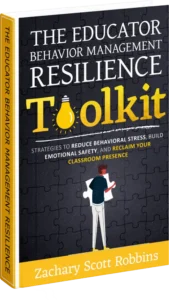
Dr. Zachary Robbins is the author of Behavior Management Resilience Toolkit, a practical framework focused on sustainable classroom management, teacher resilience, and emotionally healthy learning environments.